

Gas prices are up. For businesses running fleets, this shows up directly in the weekly fuel bill.
But more of this bill is in your control than you think.
Two fleet managers who have been through price spikes before and are not panicking joined a webinar recently to share what they’re doing.
Chad Robinson is Sr. Manager of Asset Control at 1-800-PACK-RAT, a portable storage and moving company running about 350 medium-duty trucks coast to coast. Austin Mitchell is the Corporate Fleet Manager at Colony Hardware, where the spike translated into a roughly $20,000 weekly increase in fuel spend. Both of them had controls and systems in place before prices moved. Those systems are doing the work now.
Here is what they shared.
Pick the station. Don’t leave it to the driver.
Within a single zip code, fuel prices regularly vary by 30 cents per gallon (per Coast transaction data across hundreds of thousands of fill-ups). For a fleet that fuels up dozens of times a week, the difference between the cheapest and most expensive stations in the same area adds up quickly.
Austin’s approach: he built a spreadsheet ranking every station within 25 miles of each branch by rebate, from highest to lowest. Branch managers get it quarterly and pass the list to their drivers. At the top-performing stations, he’s capturing rebates of 30¢ per diesel transaction. The list removes the guesswork. Drivers don’t have to think about it, they can just follow the directions.
Chad’s approach: he blocks the stations he doesn’t want drivers using directly in Coast. The cards will get declined there. After a few declined transactions, drivers stop trying entirely. As he puts it, once you tighten the controls and explain why certain stations are off limits, the behavior follows.
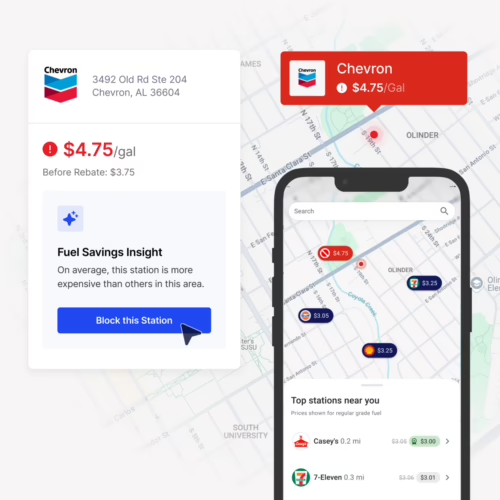
Both approaches work for the same reason: the decision is taken out of the driver’s hands. Drivers are not thinking about cost per gallon. They’re focused on getting to the next job. The controls handle it.
Your fraud controls matter more when margins are thin.
Neither Chad nor Austin changed their monitoring approach because of the price spike. The controls were already at their tightest.
They both shared their playbook for tight fuel card controls:
Chad’s playbook:
- He uses fuel-only cards at gas stations, with per-transaction and daily limits.
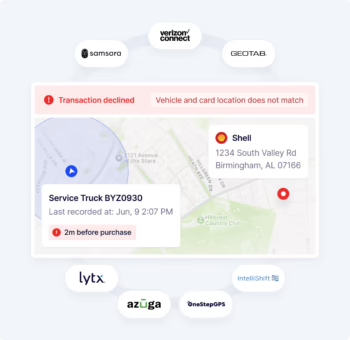
- He uses a telematics integration to block purchases when the vehicle is not at the station, with a GPS radius as tight as it will go.
- His managers are in Coast daily reviewing transactions and confirming receipts.
His framing on fraud: it is not a matter of if, it is just how much it happens and for how long. Complacency is where the problems start.
Austin’s playbook:
- Before Coast, Colony Hardware had nine separate fuel accounts. Keeping up with all of them was a mess. Consolidating into one system with telematics connected made the daily review manageable.
- He reviews flagged transactions every morning, cross-referenced against Samsara.
- Nine out of ten flags have an innocent explanation. The tenth gets escalated to the branch manager to address with the driver directly.
Telematics and your fuel card work better together.
Most commercial fleets are already using telematics. The question is whether it’s connected to the fuel card. Coast customers who pair the two see an average of 72% more fuel savings than those who don’t*. The GPS confirms the vehicle is at the station before the card works. The odometer data flags when what went into the tank doesn’t match what was purchased.
Austin described Samsara and Coast as closing the loop. Transactions are visible in real time. Flags are surfaced immediately. Everything flows through to Coast, so the reports are there when you need them—without the manual work that came with nine separate accounts.
Chad has used telematics to track idle time for close to 15 years. Years ago it was north of 20% of engine hours across the fleet. It is now around 8-9%. Tracking it weekly via telematics, keeping it in front of the operations team, has moved that number consistently in the right direction.
With fuel prices where they are, that work is paying off.
Rebates are the most underused lever.
You cannot control the price per gallon. You can control whether your team is capturing rebates every time they fill up. Up to 9 cents per gallon is available at Coast partner stations, and for a fleet fueling several hundred gallons a week, that is thousands of dollars per year just from choosing the right station consistently.
Austin turned rebate capture into a competition. Every month, he shares the data by branch so every branch manager has a report showing how much their branch earned in rebates that month. Not only is it bragging rights, but branch managers watch their P&Ls, so any chance to add back to it gets their attention.
Chad watches his rebate-per-gallon rate week over week. He is averaging 8 cents per gallon across 350 vehicles at 80-plus locations and knows there is room to go even higher. The weekly number tells him whether station behavior is actually improving.
If your fuel bill just jumped, and you don’t know where to start…
Austin’s advice? Get organized first. Know your fleet. Stay on top of preventive maintenance. Watch idle time. Have your telematics talking to your fuel card. When those things are in place before a spike hits, you’re managing through it, not starting from scratch.
Chad’s version? Get the right people in the right roles. The technology works when the people responsible for it are bought in at every level of management. The challenge is never the tool. It’s getting everyone pushing in the same direction, and making sure they understand why, not just what.
Both of them had these systems in place before prices moved. That is the point. You build them when you have time to do it right. When you need them, the work is already done.
Check out the recording of this session here.
*Average savings based on a survey conducted by Coast in October 2025, with a total of 132 respondents, 25 of which use both Coast and Samsara. Your actual savings may vary.
If you want to walk through any of the features we discussed, reach out to your account manager or visit book a call with our sales team