

Nobody likes spending money on fuel. But for fleets, it’s unavoidable…and too often unpredictable.
One month, fuel costs look stable. And the next, they’ve jumped 12%, with no obvious change in operations.
The explanation isn’t sitting in one clear report. It’s buried in dozens, sometimes hundreds, of individual transactions. You don’t have time to sift through every receipt. But you do need to stop fuel costs from creeping higher.
In this article, we’ll break down how to reduce fleet fuel costs when expenses are spiraling. We’ll cover:
- Why fleet fuel costs are difficult to manage
- Five practical ways to reduce fleet fuel costs in your business
- How Coast has helped real businesses reduce fuel costs, improve oversight, and limit fraud-related losses
What you’re up against: Why fleet fuel costs are difficult to manage
Fuel is often the largest line item in a fleet’s budget, and today’s volatile market makes it increasingly difficult to manage. Unlike fixed overheads (like insurance or leases), fuel costs fluctuate based on price changes and, more importantly, on dozens, or even hundreds, of individual decisions made across your fleet daily.
Say, for example, you manage a fleet of 50 delivery vans and 20 service cars. You aren’t just managing a single fuel bill. You’re managing the habits of 70 drivers across hundreds of miles each day. When a driver fills up at an expensive fuel station just because it’s closer, takes a slightly longer route to avoid traffic, leaves the engine idling during a delivery, or buys fuel for personal use on company funds, the impact may seem negligible.
However, if each vehicle incurs just $3 in avoidable fuel spend per day, that adds up to over $4,000 in lost revenue per month.
5 easy-to-implement ways to reduce fleet fuel costs in your business
Even when fuel prices are high, there are still ways to reduce your fleet’s fuel spend. Here are five that make the biggest difference to your bottom line:
1. Start with visibility: You can’t reduce what you can’t see
If you can’t see who is buying fuel, where they’re buying it, or how often it happens, you have no clear way to explain cost spikes or prevent recurring issues.
However, with full visibility into your operations, patterns are easier to spot. You can see:
- drivers who refuel more often than others on similar routes
- drivers that always buy from higher-priced stations
- purchases made outside work hours
- or fuel volumes that don’t match a vehicle’s tank size.
These details show exactly where you lose money, which makes it easier to fix the problem.
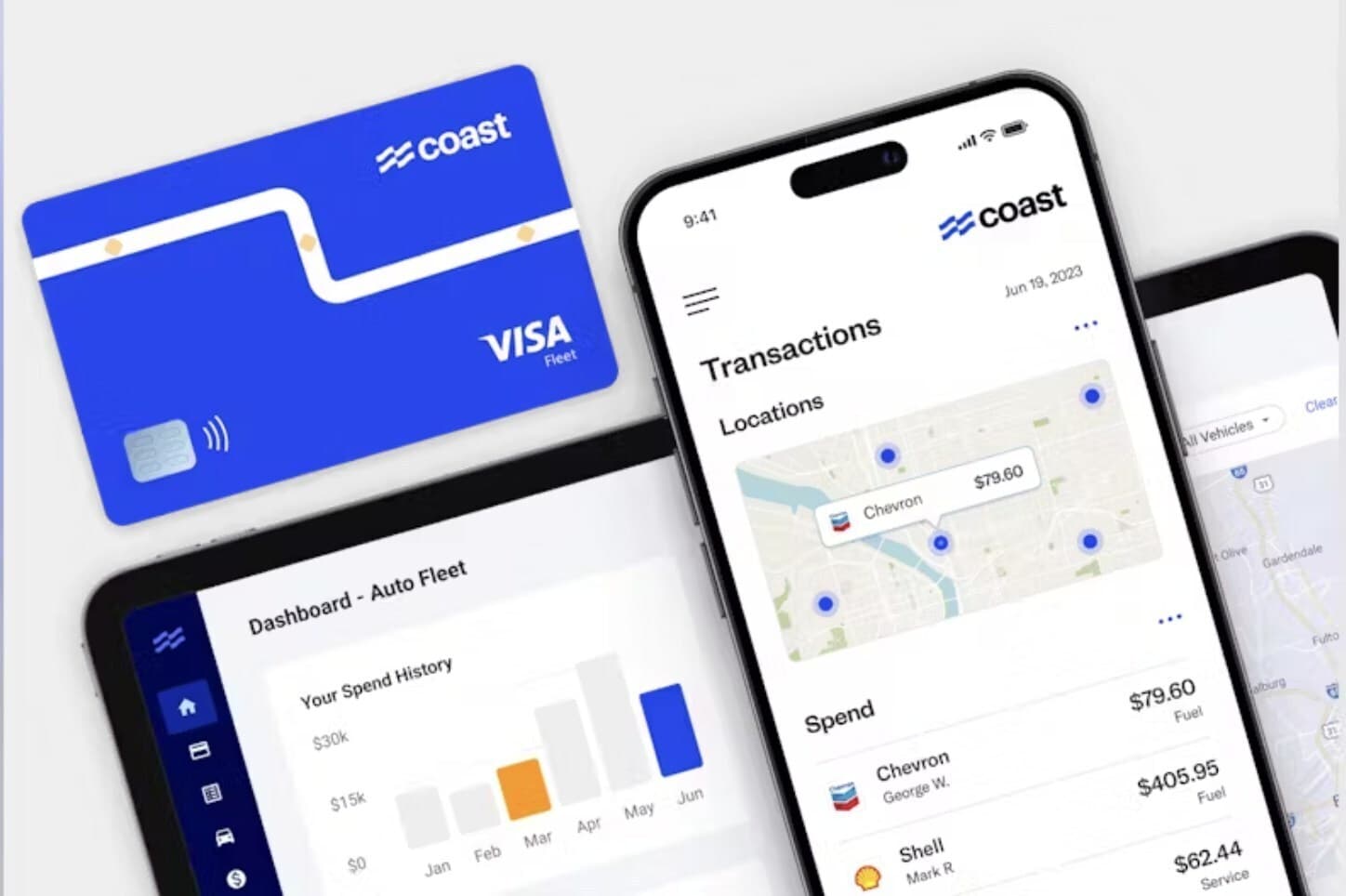
Fuel cost management tools like Coast can provide that visibility. Coast provides fuel cards that you dynamically assign to individual drivers or vehicles and manage through a central dashboard. In the dashboard, you can see which driver made a purchase, where it happened, how much fuel they bought, and how much they spent.
With that level of detail, fuel spend becomes something you can actively manage and reduce.
2. Use spend controls to reduce waste before it happens
Fuel cards give you the option to turn on spend controls. Spend controls let you set clear limits on fuel purchases, prevent purchases that are not fuel, and block out-of-policy transactions before they occur, which makes cost control far more effective.
These controls don’t need to be complex to work. Daily or weekly spend caps help reduce over-fueling; time-based controls reduce fuel purchases late at night or outside working hours; and day restrictions block drivers from fueling on predefined days. These rules protect your budget and remove uncertainty about what is and isn’t allowed.
For example, Coast lets you apply spend controls to each fuel card. You can set daily or weekly spend limits (e.g., $300 per day or $1,000 per week), define purchase hours (e.g., 8 am to 5 pm), and restrict use to specific days (e.g., Monday–Friday). If a transaction falls outside those rules, it won’t go through.
This helps reduce out-of-policy spending before money leaves the account, effectively reducing fleet fuel costs on a monthly basis.
3. Prevent fuel fraud before it drains your budget
Fuel fraud is more common than many fleet managers expect. Shared cards, manual receipts, and limited controls make it easy for misuse to go unnoticed. Over time, small incidents add up to significant losses.
Common types of fuel fraud include:
- Drivers sharing fuel cards or PINs with others
- Fuel purchased for personal vehicles
- Transactions that exceed a vehicle’s tank capacity
- Multiple fuel purchases made back-to-back
Without safeguards in place, these issues often only surface after money has already been spent.
Fleet fuel cards with built-in fraud protection help stop this.
In addition to the spend controls, Coast connects to telematics and uses GPS and fuel tank insights to provide more fuel controls. That means fleet managers can:
- Block transactions automatically when the company vehicle isn’t near the gas station
- Flag gallon mismatches between fuel purchased and what actually goes into the tank
- Set transaction limits to control spend
- Restrict cards to fuel-only purchases
- Receive real-time alerts when suspicious activity occurs
And just in case, Coast comes with a fraud guarantee of up to $25,000 per year, covering both internal and external fraud (subject to eligibility requirements and program terms).
By preventing fraud at the point of purchase, fleets avoid unnecessary fuel spend and reduce the time spent investigating discrepancies later.
4. Give your drivers the flexibility to buy cheaper fuel
Fuel prices vary widely between stations, even within the same area. When drivers can only fill up at a specific network like Shell, they may end up paying higher prices than are available at the non-network station across the road.
Giving drivers more flexibility allows them to choose stations with better prices along their route. Saving a few cents per gallon may not seem significant at first, but across multiple vehicles and regular refuelling, those savings add up quickly. Flexibility also reduces unnecessary detours, which saves both fuel and time.
Coast cards, for example, work anywhere Visa is accepted, including most fuel stations nationwide. This open-network approach allows drivers to refuel at stations that fit their route and budget, while managers retain visibility into and control over card usage. At the same time, Coast allows fleet managers to give more guidance to drivers, by blocking specific stations, or only allowing their preferred locations.
This balance between flexibility and oversight helps fleets reduce fuel costs without slowing down daily operations.
5. Get a fleet fuel card that offers rewards
Even with spending controls, fuel still costs money. Rewards help you earn some of that spend back. Discounts, rebates, and cash back lower the actual price you pay per gallon, which adds up across your fleet.
Many fuel cards offer rewards, but the structure varies. Some offer per-gallon rebates at partner stations. Others provide cash back or points that apply to fuel or maintenance expenses. The most useful rewards are the ones that fit naturally into how your fleet already fuels and maintains vehicles.
Coast offers rebates of up to 3–9 cents per gallon at over 30,000 partner stations, depending on location and station availability. It also provides up to 1% cash back on eligible non-fuel fleet spend, such as oil changes and vehicle maintenance. Across multiple vehicles and regular purchases, these rewards help offset fuel costs without inconveniencing drivers.
You may also like: 14 Best Fleet And Fuel Cards For Businesses In 2025
3 companies that gained control over their fleet’s fuel expenses with coast
Here are some companies that used Coast to get better visibility into their daily operations and regain control over their fleet fuel costs.
Note: Customer quotes reflect individual experiences and opinions. Results vary and are not guaranteed.
1. KD Construction

Problem
Before using Coast, KD Construction managed fuel and project expenses through employee reimbursements, which created a fragmented paper-based system that slowed down accounting workflows.
This made construction fleet management fuel costs difficult to track and even harder to control. The accounting team had little visibility into what employees spent or whether purchases stayed within budget. The staff chased receipts, verified mileage, and manually processed checks each month. And audits required stacks of paperwork that took a long time to process. As a result, accounting spent weeks each month on work that added little operational value.
Solution
To fix this situation, KD Construction replaced reimbursements with Coast cards issued to employees. The team used Coast to set spending limits by employee and project, require odometer readings for fuel purchases, and collect receipts and memos directly in the system.
With Coast, managers gained real-time visibility into spending, could turn cards on or off as needed, and could customize policies by regions or departments, if necessary. This freed the AP team up to focus on more strategic work, instead of repetitive tasks.
“Our AP clerk now has time to focus on other things,” says Sania Salas, Executive Vice President of Business Operations at KD Construction. “She’s expanded her position—she’s doing training, learning more, and backing up other people.
Coast has really brought a lot of value because we’ve been able to save a lot of time for work that was very manual. Now, we’ve created a very automated process that’s easy to track and easy to use.”
Results
After adopting Coast, KD Construction:
- Saved weeks of accounting time every month
- Eliminated check runs and manual receipt chasing
- Simplified audits with digital, centralized records
- Improved project budget tracking and job costing accuracy
- Freed the AP team to focus on training and higher-value work
2. Communications Unlimited

Problem
Communications Unlimited (CUI) managed fuel spend across a fleet of about 200 vehicles spread across multiple states. Drivers regularly switched vehicles, which made it hard to track who was using fuel and where the vehicle was going.
Their previous fuel card provider offered limited controls, which left room for card misuse, lost cards, and unclear accountability.
Solution
CUI switched to Coast to gain tighter control over driver fuel spending. The company assigned fuel cards to individual drivers rather than vehicles and required drivers to log in for each transaction. Coast’s customizable controls helped managers restrict how the cards could be used, which improved accountability across the fleet.
“There’s a lot of potential for abuse that became virtually impossible with Coast,” said Ed Keeley, the Director of Business Intelligence and Analytics at CUI.
CUI also integrated Coast with One Step GPS to link fuel purchases with real vehicle location data. This integration allowed the team to confirm that fuel purchases happened at actual fuel stations and went into the correct vehicles
Results
After implementing Coast, CUI:
- Reportedly saved approximately $22,000 in fuel costs in the first month after switching to Coast
- Reduced misuse by tying cards directly to drivers and enforcing login requirements
- Gained real-time visibility into where fuel was purchased and which vehicles received it
- Improved accountability by linking fuel spend with GPS location data
- Completed a smooth transition with strong onboarding and customer support
3. Rockit Pest

Problem
As Rockit Pest grew to more than 380 vehicles across multiple states, its fuel program became harder to manage and more expensive. The company relied on a legacy fuel card system that created fragmented accounts, made it hard to replace cards, and had weak security.
Drivers could make unauthorized purchases, fuel theft was difficult to detect, and enforcing spend policies required a manual review that rarely caught issues early.
Solution
Rockit Pest switched to Coast to simplify card management and tighten control across its growing fleet. The company used Coast’s spend controls to block non-fuel purchases and enforce clear rules at the pump. Rockit also integrated Coast with Azuga, its telematics platform, to enable geo-fenced fuel authorization.
“We’ve had people steal thousands of gallons before. Just being able to block fuel access unless the vehicle is actually at the pump? That alone is worth switching,” said Jay Walter, the Vice President at Rockit Pest.
Text-based authorization added another layer of security, and Coast’s support team helped roll out the program quickly across branches.
Results
After rolling out Coast, Rockit Pest:
- Reportedly saved $30,000–50,000 annually from improved fuel rebates alone
- Eliminated unauthorized purchases such as car washes and in-store items
- Prevented fuel theft through geo-fencing and telematics-based rules
- Gained automated, branch-level visibility into fuel activity by vehicle and driver
- Reduced operational friction with faster card management and rollout
Stay in control and reduce fleet fuel costs with coast
Fuel prices may be high, but your fuel spend doesn’t have to be out of control. You can reduce fleet fuel costs by improving visibility into your daily operations, setting clear spending rules on fuel cards, giving drivers flexibility to fuel at lower-priced stations, and preventing fraud.
Coast’s fleet fuel cards and expense management platform helps you do this. You’ll get fuel cards you can dynamically assign to individual drivers and/or vehicles, real-time visibility into fuel spend, and flexible controls that allow you to define how each card should be used. The system logs every transaction, including who made the purchase, where it happened, and when it occurred, and stops unauthorized spending before money leaves your account.
To deepen insight, Coast integrates with telematics platforms such as Samsara and Geotab, which link fuel spend to vehicle usage, mileage, and routes. This makes it easier to spot inefficient driving behaviour, fuel volume mismatches, or routes that increase fuel costs.
Because Coast fuel cards run on the Visa network, drivers can fuel at any station that accepts Visa instead of being limited to a small network. Coast also offers rebates of 3¢–9¢ per gallon at 30,000+ partner stations and 1% cash back on non-fuel fleet spending, which can help reduce the cost of everyday operational needs such as repairs, tolls, and parts.
On the security side, Coast monitors transactions for suspicious activity so you can act quickly. It backs this protection with a fraud guarantee of up to $25,000 per year, covering both internal and external fraud (subject to eligibility requirements and program terms).
These features help you stay in control of fuel costs and overall fleet expenses, even when prices rise.
If you want to see how Coast works in real fleet operations, apply now.