

What is a fleet card?
A fleet card is a specialized payment card that companies give drivers to pay for fuel and other fleet-related expenses, such as maintenance, repairs, car washes, oil changes, parking, and tolls.
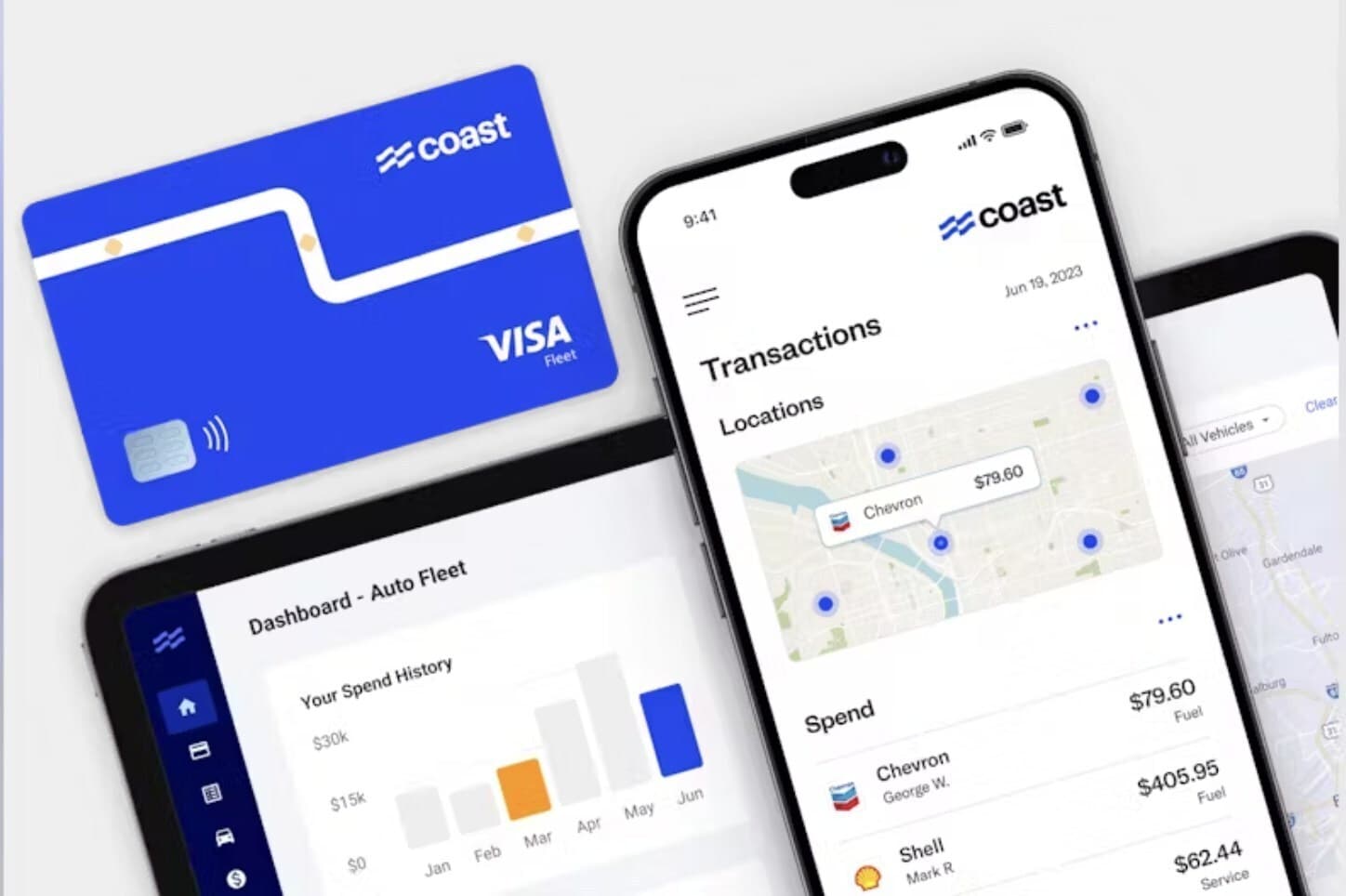
A fleet card automatically records spend, capturing details like what the driver bought, where and when the purchase occurred, and which vehicle was serviced.
This information appears in a central system, so fleet managers don’t have to collect receipts, issue reimbursements to drivers, or piece together expense reports. Instead, they can see how money is spent across the fleet in a single dashboard.
Put simply, a fleet card helps drivers spend responsibly on fuel and vehicle-related expenses, while fleet managers can oversee expenses in real time.
Fleet fuel card vs credit card: Differences at a glance
A credit card can be used to pay for fuel and fleet expenses, but it’s not designed to help businesses track, control, reduce, or explain fleet-wide fuel and vehicle costs. Fleet fuel cards are.
Here’s a side-by-side look at how they differ.
| Category | Fleet fuel card | Credit card |
| Visibility and reporting | Every transaction is tied to a driver and vehicle, and shows fuel-specific insights such as number of gallons of fuel grade, making it easy to see who spent what and why. | Charges show a dollar amount and merchant name, with no built-in link to a driver or vehicle. |
| Spend controls and restrictions | Managers can limit spending by fuel type, merchant category, dollar amount, day, time, or location before purchases happen. | Controls are limited to overall credit limits, and spending issues are usually reviewed after the fact. |
| Admin and reconciliation | Fuel data automatically flows into reports, which elimi receipt collection and manual expense reviews. | Teams often rely on receipts, spreadsheets, and follow-ups to understand charges. |
| Driver and vehicle tracking | Cards can be assigned to specific drivers or vehicles, which creates clear ownership and accountability. | Cards are often shared or reused, which makes it difficult to track who’s responsible for each charge. |
| Fleet-specific insights | Reports can show patterns like unusual fuel usage, duplicate fills, or spending outside normal routes. | Credit card statements do not provide insight into fuel behavior or fleet operations. |
Who typically uses fleet cards?
Short answer: Any company that operates a fleet of vehicles, usually five or more. This includes:
- Construction and trades companies. Electricians, plumbers, and landscapers often have multiple trucks on the road each day. Fleet cards help them track fuel spend by crew or vehicle and cut down on receipt chasing.
- Healthcare and emergency services: Hospitals, clinics, and ambulance services use fleet cards to monitor fuel usage across vehicles that operate on fixed routes and tight schedules.
- Delivery and logistics businesses: Companies that run local or regional deliveries rely on fleet cards to understand fuel costs per route and manage spending across many drivers.
- Utilities and field service teams. Utility providers and field service providers, such as pest control, HVAC, and solar companies, use fleet cards to control fuel spend while keeping vehicles moving without delays or detours.
- Government agencies and municipalities. Public sector fleets use fleet cards to improve oversight, ensure policy compliance, and simplify reporting across departments.
- Private equity firms. Fleet cards help standardize fuel spending and improve visibility across multi-entity firms with vehicle fleets.
Fleet cards give these organizations a simple way to pay for fuel while keeping spending visible, controlled, and easy to manage as operations grow.
Types of fleet credit cards available
There are two main types of fleet fuel cards: closed-network fuel cards and open-network fuel cards.
Closed-network fuel cards
A closed-network fuel card, also called a closed-loop card, only works within a specific network of fuel stations.
They can either be limited to specific brands, like Shell or ExxonMobil, or give access to a broader range of stations, like Fuelman or Wex cards.
Closed-network cards often offer fuel rebates of up to 15¢ per gallon because fuel brands want to encourage repeat purchases.
This setup can work well for companies that buy large volumes of fuel and operate near the same stations each day.
The tradeoff, however, is flexibility. If a driver needs fuel and the nearest station falls outside the network, the card won’t work.
This can force drivers to adjust their routes to find an approved station, even if they can get cheaper fuel nearby.
Taking detours also slows down operations for fleets that travel long distances, operate in rural areas, or run time-sensitive vehicles such as ambulances and field service trucks.
Open-network fuel cards
An open-network fuel card runs on major payment networks like Visa or Mastercard.
Instead of being tied to specific fuel brands, it works at any location that accepts those networks, which is about 99% of fuel stations and truck stops nationwide.
Coast, for example, can be used anywhere Visa is accepted. With Coast, drivers can refuel at large chains like Shell, Exxon, and Costco, as well as independent local stations.
They can also pay for repairs or maintenance at any shop that accepts Visa, so they don’t need to detour or search for a specific brand.
Open-network cards often provide fuel savings through preferred station networks. For instance, Coast has a network of more than 30,000 fuel stations where drivers can earn rebates of about 3¢ to 9¢ per gallon, plus 1% cashback on non-fuel expenses.*
This gives fleets the flexibility to fuel anywhere, while still earning discounts when they refuel within the network.
Five fuel card advantages you won’t want to miss
Beyond being a convenient way to pay for fuel, fleet cards offer several practical advantages that help businesses manage day-to-day fuel and vehicle spending.
They include:
1. Better visibility into fuel spend
Fuel cards capture Level 3 data, which means each transaction includes details like the exact location, date and time of purchase, fuel grade, gallons pumped, and even the odometer reading at the pump.
This level of detail makes it easier to spot patterns, such as unusually frequent fills, premium fuel purchases when not required, or purchases made far outside the normal route. Instead of guessing why fuel spend is rising, you can clearly see what’s driving the change and address issues early, before they drain the budget.
2. More control over how each card is used
Fuel cards let you set customized purchase rules for each card, so you decide exactly how company money can be used. For example, you can:
- Limit purchases to certain days or times, such as weekdays between 8 am and 5 pm
- Set spending limits, like a maximum of $500 per week per card
- Choose whether a card should be used only for fuel or also for related expenses like maintenance or car washes
- Restrict where cards can be used by defining approved regions or locations
These controls help reduce card misuse while keeping fuel and vehicle spending aligned with company policy and day-to-day operating needs.
3. Less admin and manual expense tracking
Instead of manually entering fuel charges into spreadsheets, fleet fuel cards automate the documentation process by consolidating all transactions into a single, tax-ready report. This reduces errors and cuts down the time back-office teams spend reconciling expenses or processing reimbursements.
This can save hours of administrative effort each month, especially for large fleets that refuel daily.
4. Easier cost allocation by driver or vehicle
Most fuel cards require unique identifiers, such as a Driver PIN or Vehicle ID, at the pump, which digitally links each transaction to a specific driver and vehicle. This makes it easy to see how much fuel each driver uses and what each vehicle costs to operate.
Some fuel cards also require odometer readings for each transaction, allowing you to calculate fuel efficiency (MPG) and spot vehicles that burn more fuel than expected.
These data points are aggregated into centralized dashboards, where you can filter expenses by driver, vehicle, or department.
This helps you allocate costs accurately across the fleet, build more realistic budgets, and make informed decisions about routes, vehicles, and resource allocation as your operations grow.
5. Ability to cover non-fuel fleet expenses
Modern fuel cards like Coast are no longer limited to fuel. Many now support related fleet expenses such as car washes, oil changes, tire rotations, and routine maintenance. You can control which expenses are allowed on each card based on the driver’s role or the needs of a specific vehicle.
This reduces the need for separate cards or reimbursement processes for everyday vehicle expenses. Drivers use one approved payment method, and fleet spending stays centralized without adding extra tools or steps.
How fleet cards work day-to-day for drivers and fleet managers
Let’s look at how a fleet card actually works in day-to-day operations, using Coast as an example.
How drivers use a fleet card at the pump
Drivers using Coast cards at the pump authorize fuel purchases through a modern, SMS-based process. A typical fuel stop looks like this:
1. Activate or unlock the card
Coast cards are locked by default for security. So, when a driver is ready to fuel, they simply unlock it through a mobile app, or send a text message with the card’s ID (printed on the front of the card) to Coast’s authorization number.
Coast then prompts the driver to enter required details, such as their driver ID, vehicle information, and current odometer reading. Once those details are confirmed, the card is unlocked for use.
2. Complete the transaction at the pump
The driver then swipes the card at the pump, selects the fuel grade, and fills the tank as usual.
Note: If Coast is connected to telematics/GPS platforms like Samsara or Geotab, the system will cross-check the vehicle’s GPS location against the fuel station at the time of purchase. If the vehicle isn’t physically at the pump when the card is used, the transaction may be flagged or declined immediately to help prevent unauthorized purchases.
How fuel purchases are tracked and reported
Every time a driver uses a Coast card, the system automatically captures and uploads transaction data to the backend system. This includes the number of gallons purchased, the price per gallon, the total cost, the fuel grade, the exact station location, and the time of purchase.
Depending on how the account is set up, the driver may also be prompted to take a photo of the receipt and submit it by text or app, which simplifies bookkeeping and audits.
Coast displays all of this information in a centralized dashboard, giving managers a clear, up-to-date view of fuel activity across drivers and vehicles.
How fleet managers oversee spend
For fleet managers, Coast makes it easier to see, control, and review fuel and vehicle spending in one place. With Coast, managers can:
- Set and enforce spending rules. Managers can control how each card is used by setting limits by dollar amount, time of day, day of the week, location, or purchase type. These rules apply automatically and help keep spending aligned with company policy.
- Monitor activity in real time. Transactions appear on the dashboard shortly after they happen, so managers can see who fueled, where it happened, what was purchased, and how much it cost, without waiting for a manual report.
- Track fuel efficiency and vehicle performance. When Coast is integrated with telematics platforms, odometer readings sync automatically, making it easy for managers to calculate miles per gallon (MPG), flag vehicles that use more fuel than expected, and see how much it costs to manage each vehicle.
- Keep accounting in sync. Coast also integrates with accounting tools such as QuickBooks and NetSuite, which automates reconciliation, reduces manual entry, and ensures fuel expenses are properly categorized in the books.
Together, these tools give managers a clear, current view of fleet spending and the ability to step in quickly when something looks off.
Are fuel cards worth it?
Often, yes—but it depends on your fleet size, the routes your drivers follow, and the controls you need. Here are some scenarios where fleet cards make sense and when they might not be needed.
When fleet cards make sense
Fuel cards are a good fit when fuel spend is frequent enough that manual tracking can’t keep up.
Here are some signs that your business and drivers would benefit from a fleet card:
- You operate five or more vehicles: When you have a fleet, managing fuel receipts manually becomes time-consuming and tedious. Fuel cards consolidate all spending into one monthly statement, saving significant time in accounting.
- You need to control fleet expenses and reduce fraud: Unlike credit cards, you can set very specific limits on fuel cards: daily/weekly limits, gallon caps, dollar limits, and even time-of-day restrictions. Fuel cards also require PINs and/or odometer entries, which help reduce unauthorized purchases.
- You want to save money on fuel: Many cards offer rebates of up to 15¢ per gallon, especially when fueling at designated or network-affiliated stations.
- You need detailed reporting: Fuel cards capture detailed data for every transaction, including the date, time, location, gallons, and price per gallon. This is essential for tracking fuel efficiency (MPG) and identifying vehicles that consume too much fuel.
- You need to streamline accounting: Fuel cards tie spending to a specific driver or vehicle, automating expense reporting and eliminating the need to collect paper receipts or process reimbursements.
When fleet cards might not be needed
- You have a very small fleet with low usage: If you have just two or three vehicles and your drivers rarely fill up (e.g., less than 200 gallons per month), the monthly fees, card fees, or setup fees of a fuel card might exceed the rebates, making them less cost-effective than using a standard business credit card.
- You have fuel tanks on site: If you have a very large fleet or heavy equipment, having tanks on your construction site can be beneficial. In this case, fuel cards would only be helpful for one-off fill-ups. .
- Spending is already easy to track: If your fuel charges are few and simple to reconcile, you may not need dedicated fuel cards with a robust backend system for displaying and reconciling transactions.
What to look for in your fleet fuel card
When choosing a fleet fuel card, it helps to know which features will matter most for your day-to-day operations.
Here’s what to look for as you evaluate options:
1. Network acceptance and coverage
One of the first things to check is where the card can actually be used. Closed-loop cards work only at specific fuel brands, while open-loop cards run on major payment networks like Visa and Mastercard, which are accepted at up to 95% of fuel stations and auto service locations nationwide.
If your drivers travel long distances, cover different routes, or operate across multiple regions, open-loop cards like Coast make it easier to refuel along their routes without taking detours. But if your fleet operates within a small, defined area and refuels at the same stations each time, a closed-loop card with strong rebates may be a better fit.
2. Customizable spending controls
Not all fleet fuel cards offer the same level of control. Some only allow you set spending caps, while others have flexible controls that let you define exactly how each card should be used. At a minimum, your card should allow you to:
- Restrict purchases by time of day or day of the week
- Set spend limits (per transaction, per day, or per month)
- Whitelist specific merchant categories (e.g., fuel-only vs. fuel and maintenance)
These controls help reduce card misuse and unauthorized purchases while keeping fuel and vehicle spending aligned with company policy.
3. Transparent fee structures
Fuel card pricing can be notoriously complex. Beyond the monthly “per card” fee, keep an eye out for:
- Transaction fees: These charges are applied every time a driver swipes.
- Portal or membership fees: Flat monthly costs to access the software.
- Hidden “service” charges: Fees for things like paper statements or account maintenance.
Pro tip: Look for a provider with a flat-fee or no-hidden-fee model so your savings are predictable and easy to calculate.
4. Easy to set up and use
A fleet fuel card should be easy to roll out and simple to use from day one. You should be able to order cards, assign them to drivers or vehicles, and set basic rules without a long onboarding process or technical support.
Day to day, the system should feel straightforward for everyone involved. Drivers should be able to fuel up without confusion, while managers can make updates, adjust limits, or add new cards as the fleet scales.
A card that takes weeks to set up or is hard to manage defeats the purpose of using a fleet card in the first place.
5. Real-time data and reporting
The fuel card you choose should offer a centralized dashboard that shows you what’s happening across the fleet in real time. The dashboard should let you:
- View transactions as soon as they occur, not days or weeks later
- See how much each driver spends and what each vehicle costs to operate
- Activate, assign, pause, or lock cards instantly if one is lost or stolen
- Monitor exceptions, like a driver purchasing more fuel than their vehicle’s tank can hold
This makes it easier to spot issues early and respond quickly, instead of uncovering them during a month-end review.
Pro tip: Choose a card that also offers a mobile app. This lets drivers enter details at the pump and gives you access to transactions and dashboards on the go.
6. Integration with fleet technology
To get the most value from a fleet fuel card, it needs to connect with the systems you already use to run your business.
Look for a card that integrates with:
- Accounting software such as QuickBooks or NetSuite, so fuel and vehicle expenses flow directly into your books. This helps automate reconciliation, reduce manual entry, and keep financial records up to date.
- Telematics and GPS tools like Samsara or Geotab, so the system can check fuel transactions against vehicle location data. This helps confirm that the vehicle was at the same location where fuel was purchased.
When fuel data connects with the rest of your fleet technology, it becomes easier to spot inconsistencies, improve oversight, and make better decisions across the entire operation.
Coast: The fleet card that saves you time and money
Fleet cards help businesses bring order to everyday fuel and vehicle spending. They replace manual tracking with real-time data, add guardrails around how cards are used, and make it easier to understand costs as fleets grow.
If you’re looking for an open-network fleet card that offers strong rebates and gives you visibility into and control over fleet operations, Coast is a solid choice. Coast can be used wherever Visa is accepted, from fuel stations to repair shops and other vehicle-related merchants.
Coast also offers fuel rebates of 3–9¢ per gallon at more than 30,000 fuel locations, along with 1% cashback on non-fuel purchases. Flexible card controls help keep spending aligned with policy, while the real-time dashboard helps managers see activity as it happens.
Coast also integrates with telematics and accounting platforms to help reduce fraud, improve manager oversight, and automate reconciliation.
If you’d like to see how Coast can help your business reduce fuel costs and gain control over fleet expenses, apply today.