
Subscribe and get unlimited access to Coast’s blog.
The price per gallon is set by the market. Your fuel bill isn’t. Station selection, driving habits, spend controls, rebates— those are yours to manage, at any price.
That distinction matters most when prices spike. Every time fuel prices climb, two kinds of fleet operators emerge. The ones scrambling to find new levers to pull. And the ones who already have their levers in place, watching the same headlines with a lot less anxiety.
Right now, that difference is playing out in real time. Diesel is up more than 50% in two months. Managers are asking for tighter reporting. Operators are considering raising prices to customers. 86% of fleet operators surveyed during the current spike say they are already acting or actively exploring options. Most of this action is reactive—a response to a number that already moved.
This playbook is about the other approach. Four things that reduce your fuel bill, whether prices are high or not. They fall into four themes: Station Selection, Spend Controls, Driver Behavior, and Rebates. All are worth building now, so they will be working in the background the next time prices move.
1. Station Selection
Drivers do not optimize for cost per gallon by default. They optimize for convenience. They stop where they stopped last time, where the sign is visible from the road, where the tank light turned on. This is how it works when nobody has set up a system to make the cheap option the easy option.
Within a single zip code, the price difference between the cheapest and most expensive gas station regularly reaches 30 cents per gallon. Coast sees this across hundreds of thousands of transactions every month. For a fleet filling up 50 times per week, a 20-cent-per-gallon improvement is $10 per fill-up. That is $500 per week, $26,000 per year, without reducing a single mile driven.
Taking the decision out of the driver’s hands
There are two ways to do this.
The first is enforcement: block the stations you do not want drivers using directly in your fuel card controls. The card gets declined. After a few declines, behavior changes. It is blunt, but it works quickly and requires almost no ongoing effort once it is set up.
The second is guidance: give your drivers and managers a clear, ranked list of preferred stations— ideally updated regularly and broken out by geography. Some fleet managers build this as a simple spreadsheet, pulling station data and sorting by rebate rate within a given radius of each branch or service area. Others use their fuel card’s native tools to surface the same information.
A combination of both tends to work best. Block the worst stations outright. Guide drivers toward the best ones.
HOW COAST HANDLES THIS
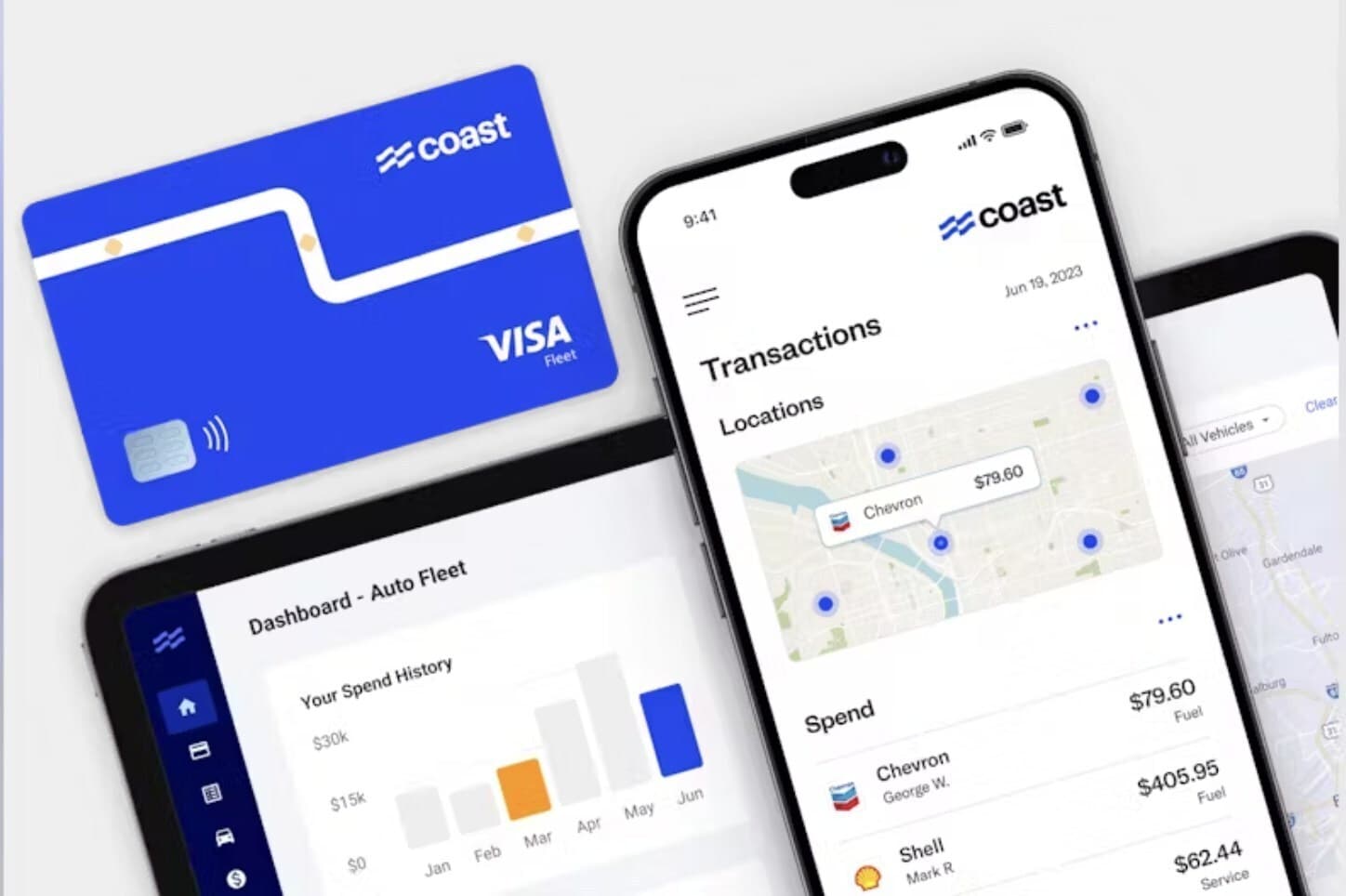
Coast shows you exactly which stations your team is using and what each one costs— including a map of price variation across your service area. From there, you can block overpriced stations in one click. Drivers can never fuel there, regardless of how convenient it is.
The Coast mobile app’s Fuel Finder feature takes it a step further. Drivers open the app when they need fuel and see a ranked list of nearby stations with real-time pricing and rebates already factored in. Approved and blocked station rules are reflected automatically. The cheapest compliant station is the first option on the list.
What to do right now
- Pull a report of where your fleet is actually fueling. If you have never done this, you will likely find more variation than you expect.
- Identify the highest-cost merchants your drivers are using regularly. Block or restrict them if the rebate picture does not justify it.
- Share a list of preferred, high-rebate stations with your branch managers or dispatch team. A simple ranked list by zip code is enough to start.
- If you use Coast, the Fuel Finder feature in the mobile app lets drivers see the cheapest compliant station near them in real time, with prices calculated inclusive of rebates. This removes the decision entirely.
2. Spend Controls
Fuel card misuse tends to rise when prices do. In the U.S., roughly 25% of fuel retailers reported higher theft during the 2022 price surge. The pattern makes sense: drivers are feeling the same price increases personally. When filling a personal tank costs $30 more than it did two months ago, the temptation to blur the line on a company card goes up.
The other thing worth knowing: complacency is where the problems start. Fleets that tightened controls before prices moved are in a better position not because fraud suddenly stopped, but because the systems were already doing the work before the incentive to misuse got stronger.
Controls you can tailor to your operation
The most effective approach is not a blanket policy— it is a set of controls configured to match how your fleet actually operates. Different drivers, different roles, different risk levels. The goal is to make spending easy where it should be easy, and impossible where it should be impossible.
Spend limits by driver or vehicle are the foundation. A transaction limit calibrated to your largest vehicle’s tank capacity flags anything unusual without generating constant false positives. Daily limits catch patterns that individual transaction limits miss. Time-of-day restrictions mean cards only work during operating hours— a simple control that closes off a wide category of misuse without affecting any legitimate purchase.
GPS verification is where controls get meaningful. When your fuel card is connected to your telematics system, you can require that a vehicle be physically at the station before the card works. If the truck is not there, the card does not work. This closes the most common version of unauthorized fueling— pulling a personal vehicle up to the pump behind the work truck and keeping the transaction running. It also flags odometer mismatches: if telematics shows a full tank and a purchase comes through anyway, that surfaces immediately.
Skimming— card readers installed on top of pumps to capture payment data— is another exposure worth knowing about. The FBI estimates skimming costs over $1 billion annually across consumers and institutions. Fleet cards that authenticate through an app or SMS check-in rather than swiping at the pump eliminate this risk entirely, because there is no card data at the pump to steal.
HOW COAST HANDLES THIS
Coast lets you configure controls at the driver and vehicle level— not just the card level. A driver who handles fuel and nothing else gets one set of rules. A manager who also buys parts, pays vendors, or handles other job-site expenses gets another. You define what spending looks like for each role.
Controls include: spend limits by transaction and day, time-of-day restrictions, GPS verification that requires the vehicle to be physically at the pump, fuel-grade restrictions, and odometer-based tank monitoring that flags purchases when the tank is already full. Coast backs these controls with up to $25,000** per year in protection against fuel fraud losses when advanced security features are enabled.
What to do right now
- Connect your fuel card to your telematics system if you have not already. GPS verification and odometer-based tank monitoring are the most effective fraud controls available.
- Review your current card controls by driver role. Not every driver needs the same configuration—tighter limits for higher-risk roles, more flexibility for managers and field staff who handle non-fuel purchases.
- Set per-transaction limits based on your largest vehicle’s tank capacity. Anything above that threshold should generate an immediate alert.
- Turn on time-of-day restrictions so cards only work during operating hours. This is a low-effort control that closes off a meaningful category of misuse.
- Pull a premium-fuel report and cross-reference against vehicle types. Repeat offenders on regular-grade vehicles warrant a follow-up.
2. Driver Behavior (Telematics)
Station controls and spend limits already shape a lot of driver behavior through policy— where they can fuel, how much they can spend, whether the card works at all. Bringing t@zach.aquino_contractor@coastpay.com can you re-design for the report telematics into the picture provides an even deeper level of visibility into what happens on the road that policy alone cannot reach: how long drivers idle, whether routes are efficient, how hard people accelerate. That data exists in most fleets already, but most are not using it for optimal fuel management.
The common telematics use cases— location tracking, dispatch, compliance— are well understood. What gets left on the table is using that same data to understand and change how drivers actually drive. According to fleet data, aggressive driving habits can increase fuel consumption by 10 to 20%. Idle time can account for a meaningful share of total fuel spend, especially for fleets with a lot of stop-and-go work or drivers who run engines while waiting at job sites.
Idle time is the most measurable place to start
Idling burns fuel without moving a vehicle. For fleets with a lot of local, stop-and-go work, idle time can represent a surprisingly high percentage of total fuel spend. According to the U.S. Department of Energy, a diesel truck burns roughly 0.8 gallons per hour at idle. A fleet of 50 trucks idling an average of 45 minutes per day is burning around 30 gallons daily just sitting still— roughly $150 per day at current prices.
The way to move idle time is not a single directive. It is consistent measurement and consistent reporting. When managers see idle numbers weekly, when field teams see their data compared to other locations, and when the expectation is set clearly and enforced over time, the number moves. Gradually, and then more quickly as behavior normalizes.
Driver coaching: the hardest lever, with the highest ceiling
Driving behavior— hard acceleration, harsh braking, speeding— can account for up to 20% of the variation in fuel consumption between similar vehicles on similar routes. That is a significant number. And it is one that requires something none of the other levers require: a direct conversation with the person behind the wheel.
The fleets that make progress here tend to do two things: they use data to make the conversation specific rather than general, and they tie the feedback to something the driver cares about. Showing a driver their idle percentage versus the fleet average is more actionable than a general reminder about idling. Tying a quarterly bonus to fuel efficiency scores changes the incentive structure.
Neither approach works instantly. But over time, both move the number.
Route efficiency and maintenance
Route optimization reduces miles driven, which reduces fuel burned. This is not a new idea, but it is worth revisiting when prices spike, because the savings per avoided mile are higher than they were six months ago. If your dispatch or routing has been running on autopilot, now is a good time to look at whether any regular routes have obvious inefficiencies.
Preventive maintenance affects fuel economy more than most fleet managers account for. Underinflated tires alone can reduce fuel efficiency by 0.2% for every 1 PSI below optimal pressure. An engine running past its oil change interval works harder and burns more fuel. These are not glamorous interventions, but they are real ones, and they compound across a large fleet.
What to do right now
- Connect your telematics to your fuel card if you have not already. GPS verification, tank-level monitoring, and odometer data all become available through the integration.
- Run a driving behavior report by driver. Identify specific behavioral patterns driving high consumption— harsh braking, excessive idling, or speeding— rather than talking about fuel efficiency in the abstract.
- Check that your vehicles are on their maintenance schedules, specifically tire pressure and oil changes. These are easy to defer and costly when fuel is expensive.
- If you have branch managers or team leads, share weekly idle and efficiency data by location. Public comparisons tend to move behavior faster than private feedback.
HOW COAST HANDLES THIS
Coast customers who connect a telematics provider to their fuel card see 72%* more fuel savings on average than those using Coast alone. That gap is driven by what the integration makes possible: GPS verification, tank-level monitoring, and odometer data, that neither system can surface independently.
-
Rebates
Most fuel cards offer different rebates at different stations. Optimizing these rebates is a big lever. To capture the opportunity, you need to make sure your drivers are fueling at the right stations. That sounds simple.
In practice it requires the same thing every other lever here requires: getting the right information to the people making decisions, and building enough accountability that it actually changes behavior.
Coast offers up to 9¢ per gallon at 30,000+ stations*** across the country. For a fleet fueling 500 gallons per week, full rebate capture is worth roughly $45 per week, or more than $2,300 per year. For a fleet fueling 5,000 gallons per week, it is $23,000 per year. The math scales directly with volume, and the only thing required is routing drivers to the right stations.
Turning rebate data into driver behavior
The gap between available rebates and captured rebates is a communication problem. The data on where to fuel and what each station pays is available in your fuel card reporting. Getting that information to the people making fueling decisions— branch managers, dispatchers, drivers— is what closes the gap.
There are a few ways to do this. A simple ranked list of preferred stations by location, shared with branch managers on a quarterly basis, is a low-effort starting point. Turning that list into a conversation rather than a memo— showing managers their rebate capture rate versus the fleet average, or versus last quarter— tends to generate more action. Some fleet operators run a monthly branch comparison, showing total rebates earned by location. It is a small thing that creates consistent attention.
Fueling behavior is one of the areas where competition among locations or drivers produces reliable results. The benchmark matters less than the visibility. When people can see how they are doing relative to others, performance tends to improve.
Rebate capture rate is your tracking metric
Rebate per gallon is a simple metric worth tracking weekly. It tells you whether station behavior is actually improving, not just whether the communication has gone out. Most fleets running a disciplined rebate program average 7 to 9 cents per gallon captured. If you are significantly below that, the gap between your actual number and your potential number is a tangible dollar figure— and it is money you are leaving on the table regardless of what prices do.
HOW COAST HANDLES THIS
Coast surfaces your rebate data in one place— by driver, by branch, by station— so you can see exactly where rebates are being captured and where they are not. The gap between your current rebate-per-gallon rate and the available maximum is a real dollar figure Coast can calculate for your fleet specifically.
For fleets already on Coast: coastpay.com/rewards shows a map of the highest-rebate partner stations in your service areas. Your account manager can pull a custom rebate analysis in about 20 minutes— at current prices, that number is worth knowing.
What to do right now
- Run a rebate-per-gallon report by driver or branch. Identify where you are capturing rebates consistently and where you are not.
- Set up a monthly rebate comparison by branch. The visibility alone tends to move behavior.
- Check coastpay.com/rewards for a map of the highest-rebate partner stations in your service areas.
- Ask your Coast account manager to pull a custom rebate analysis. At current prices, knowing your exact opportunity is worth 20 minutes.
The takeaway: Build the systems before you need them
None of what is in this playbook is a response to the current spike specifically. Station controls, rebate capture, telematics integration, fraud prevention— these reduce your fuel bill in normal markets. They reduce it more when prices are high. The spike is a reason to prioritize them. It is not the reason they matter.
The fleets that are managing through the current spike without cutting routes or raising prices are not doing anything exotic. They have clean controls. They are capturing rebates. They are actually reviewing their transaction data. They built these things when they had time to get them right.
If you are starting now, start with the two fastest wins.
- First: find the highest-rebate stations in your service areas and get that list to your branch managers this week— Coast can surface this instantly, or build a simple spreadsheet ranking stations by rebate within your operating radius. Either way it costs nothing and takes an hour.
- Second: pull a flagged transaction report, confirm GPS verification is on, and review spend limits by driver role. If either of those is not already in place, fixing it is a day’s work.
Telematics integration and driver behavior coaching take longer. Start them anyway. The fleets that come out of a price spike in better shape than they entered are the ones who used the pressure as a reason to tighten things they had been meaning to address. The systems do not stop working when prices normalize.
If you want a custom look at where your fleet is leaving money on the table— rebate capture, idle time, station mix— Coast can help you pull that analysis. Reach out to our team.
The Coast Visa® Commercial Card is issued by Celtic Bank. All card accounts subject to credit approval.
*Average savings based on a survey conducted by Coast in October 2025, with a total of 132 respondents, 25 of which use both Coast and Samsara. Your actual savings may vary.
**Find out more about the Coast Fuel Fraud Guarantee here.
***Learn more about Coast Rewards here.